Harnessing Board Diversity:Time for a Double Jump?
by Scarlett Brown
It’s been ten years since the first Women on Boards movement. So what has changed? Has diversity made our boards better? And what does the future look like? The combination of how far we have come in terms of diversity, and the ‘unprecedented’ times we live in presents a huge opportunity for doing things differently. Is now the time for a double jump?
It can be easy to forget how quickly board diversity has gone from being a pressure group agenda to being expectation of good governance. It has been nearly ten years since the UK Government commissioned Lord Davies’ ‘Women on Boards’ report (1), kicking off a decade of work to attempt to make corporate boards more diverse. While countries like Norway had quotas, in the UK we took a ‘voluntary’ approach. The aim was to persuade companies to appoint women to their boards by setting a target, annually reviewing, and naming and shaming companies that didn’t demonstrate they were making progress. Between 2011 and 2015 the proportion of women on FTSE 100 boards rose from 12.5% to 25%. Small progress perhaps, but at the time this was the most effective voluntary initiative in the world.
After 2015 the focus broadened to the FTSE 250 and the target was increased to 33% by 2020, which again was met (2). The FTSE small cap top 100 aren’t far behind, with 28% female directors in January 2020, and although the AIM-market is still lagging (15% female directors) this isn’t bad progress given they tend to have smaller boards with less public scrutiny. As of May 2020 there were, for the first time, no all-male boards in the FTSE 350. Something that at the time seemed unchangeable, has become the norm as a result of persuasion, soft regulation, investor pressure and lots of work by pressure groups such as the 30% Club and Women on Boards.
“It can be easy to forget how quickly board diversity has gone from being a pressure group agenda to being expectation of good governance”
The Business Case for Board Diversity
So does this also mean we have better boards? Lots of research has been published on the so-called ‘business case’ for board diversity (3). It usually argues that there is a relationship between companies with women directors and a whole bunch of business outcomes, such as higher profits, better reputational returns, shareholder returns or business performance. Diverse boards are said to be even more important in industries or sectors that have majority female consumers or employees, and are often connected to gender equality too, with the assumption that having women on boards leads to more gender balanced companies lower down, or is a measure of how seriously a company takes its commitment to diversity.
Not all of these claims are over-exaggerated – the symbolic value of women in senior positions is significant, and particularly for listed companies whose investors are scrutinising all-male boards. But they can be frustrating. Organisational diversity can both drive and be an indicator of company success, but to claim that simply increasing the number of women in a boardroom will directly lead to higher profits, is a wilful misinterpretation of what the board is there to do.
There are countless ways to assess how effective a board is, but we rarely start with “How successful is the company?” We start with internal measures – how effective is the board at making the decisions they need to, when they need to? Do they have the right mix of perspectives to make those decisions? A value-adding board is a complex thing, and we can’t expect to just ‘add a woman and stir’ and see better outcomes down the river. Apart from anything else, it’s a lot of pressure to put on a new female NED!
That is not to say a diverse board isn’t an asset. It can reduce ‘groupthink’ and help to change the balance of a conversation, especially when the people being appointed come from genuinely different backgrounds. Other kinds of diversity are also coming to the fore, in particular the need for boards to have ethnic diversity (something else that did not change much with the focus on gender). The pressure to increase diversity is also leading boards to refresh more often than they were before, especially given the emphasis on independence, another significant change in the last 20 years. We know, both through experience and data that teams with people from different perspectives who think differently are likely to make better decisions – assuming, of course, their perspectives are relevant to the decision being made and that the decision making process is done well and chaired well. Diversity is not without its challenges, but the rewards are undeniable.
“Building on the success of the change in attitudes towards board diversity and the ‘unprecedented times’ we live in, perhaps now is the time for boards to be even more creative with their makeup, especially if coming to the diversity conversation a little later.”
Is Now the Time for a Double Jump?
Building on the success of the change in attitudes towards board diversity and the ‘unprecedented times’ we live in, perhaps now is the time for boards to be even more creative with their makeup, especially if coming to the diversity conversation a little later.
It is a truism to say that the world is moving fast, but the skills and knowledge that boards need is much broader than it once was. Post-financial crisis there was a huge focus on the need for directors with risk experience and financial literacy, audit experience and deep understanding of financial markets. While all of this remains, the remit of responsibility for boards is bigger in 2020. Expectations are higher, and if 2020 has taught us anything, it is that the major risk coming down the track won’t be the one you expected.
At a recent (virtual) panel discussion I heard the Head of Leadership and Development of a leading audit firm talking about the impact of COVID-19. She described how they had taken a ‘double jump’: rather than just taking what they did before but delivering it online, they are using it as an opportunity to do things in a totally different way. In a short space of time their offering to employees is more bespoke, data-driven and multi-format. Take up and engagement are much higher than their previous online programmes.
We’re seeing this across all kinds of sectors – from health to business, public and charities – the upheaval caused by COVID-19 is giving us all permission and space to try things that before might have seemed too radical a shift. We’re also finding that the people around us, our colleagues, employees and customers, all seem that little bit more forgiving and comfortable with experimentation. Now is the time to be brave, and do things differently.
“While all of this remains, the remit of responsibility for boards is bigger in 2020. Expectations are higher, and if 2020 has taught us anything, it is that the major risk coming down the track won’t be the one you expected.”
This does not just apply to our business models. We have to harness this energy when it comes to our boards. The boards of the future weren’t supposed to be (just) gender balanced, they were supposed to be diverse. And in some ways the intense focus only on gender balance has been at the detriment to a real, genuine and nuanced conversation about what it is to be a diverse board. The women on boards targets did not make companies more creative about who they recruit. When I was researching board recruitment, I heard this time and time again – boards wanting ex-CEOs with 10 years of NED experience. Eight people with the same background won’t give you diversity, even if 2.6 of them are women.
Even before COVID-19 we were seeing great change in the skills needed on boards. We have five-generation workplaces, digital innovation, massive disruption, employee expectations, stakeholder engagement, culture and values, purpose, climate change… The next decade is going to need all these skills and more, and at the board level.
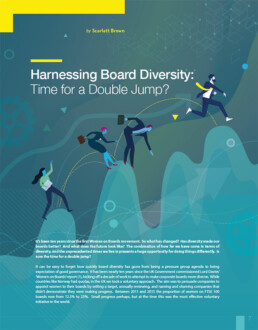
All of this means that even if your board is not gender balanced (and especially if it already is) you have the opportunity to springboard, to double-jump – to look into a future and decide what the board needs to be, and be bold. Gender is an easy place to start, but it’s not an end in itself.

Scarlette Brown
Scarlett is an independent researcher and consultant specialising in responsible business, diversity, and corporate governance. She is the co-founder of Dynamic Boards, a recruitment platform for non-executive directors. Her book, “Gender and Corporate Boards”, published January 2020, was based on her Ph.D. research into boardroom diversity and non-executive director recruitment. She was previously a Senior Analyst at Grant Thornton’s Governance Institute, and Director of Research and Tomorrow’s Company.
References
- “Women on Boards: February 2011” (Davies review) https://assets.publishing.service.gov.uk/government/uploads/system/uploads/attachment_data/file/31480/11-745-women-on-boards.pdf
- “Women on boards: 5 year summary” (Davies review) 29 October 2015 https://www.gov.uk/government/news/lord-davies-ftse-350-boards-should-be-33-female-by-2020
- Catalyst, Quick Take: Why Diversity and Inclusion Matter(August 1, 2018).
- McKinsey & Company, Delivering Through Diversity (2018). https://www.mckinsey.com/business-functions/organization/our-insights/delivering-through-diversity#
- The Parker Review into Ethnic Diversity on Boards (2017) https://www.gov.uk/government/publications/ethnic-diversity-of-uk-boards-the-parker-review
- Ethnic Diversity Enriching Business Leadership, (2020) https://assets.ey.com/content/dam/ey-sites/ey-com/en_uk/news/2020/02/ey-parker-review-2020-report-final.pdf