

The promise of artificial intelligence is undeniable. Yet for every headline-grabbing success story, countless organisations struggle to move beyond fragmented pilots and isolated experiments. Despite significant investment, many companies find themselves caught between AI hype and meaningful, scalable impact.
Drawing on over 50 executive interviews across Europe and the practical experience of the SPACE Management Consulting Network, a new white paper addresses this critical gap. “How to Effectively Initiate or Revive an Organisation’s AI Journey” provides leaders with a comprehensive navigation system to transform AI experimentation into enterprise-wide value creation.
The Core Challenge: From Experimentation to Strategic Integration
The research identifies three recurring barriers that prevent organisations from achieving AI maturity:
- Static strategies in volatile environments – AI plans often fail to adapt to rapid shifts in technology, regulation, and market dynamics. What worked six months ago may already be obsolete.
- The use case trap – Isolated pilots rarely scale without structural and cultural readiness. Success in one department doesn’t automatically translate across the organisation.
- Siloed excellence – Individual successes remain disconnected due to organisational and psychological barriers. Knowledge stays trapped rather than flowing freely.
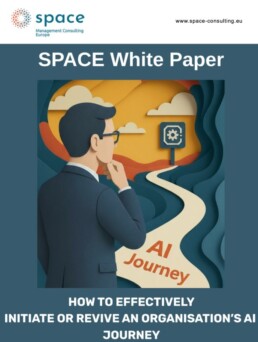
“AI is not just a technology upgrade – it is a structural, cultural, and strategic shift. Success depends on leadership commitment, cross-functional collaboration, and a human-centred approach.”
The SPACE AI Journey Model: A Holistic Framework
To overcome these challenges, the white paper introduces the SPACE AI Journey Model – an integrated framework that helps organisations navigate five critical dimensions:
1. AI Strategy & Foundations
Before any AI initiative begins, organisations must establish clear direction. This starts with defining an AI Vision and Ambition – not just what AI could do, but what the organisation specifically wants it to enable. Supporting this is an AI Charter that ensures ethical, transparent adoption aligned with emerging regulations like the EU AI Act.
Equally important are the foundations: a forward-looking data strategy that identifies which data assets will be valuable in the future, and an honest assessment of organisational culture to understand how AI will interact with existing behaviours, power structures, and emotional dynamics.
The framework includes a diagnostic model covering nine cultural dimensions, helping leadership teams anticipate risks and guide organisations through conscious, human-centred AI integration rather than letting AI simply “happen.”
2. Dynamic Roadmapping
Moving from vision to execution requires structure without rigidity. The white paper advocates for a dual-layered roadmap approach:
- Business Case Roadmap – sequences high-potential use cases based on strategic fit, readiness, and measurable value
- Radar Roadmap – continuously tracks regulatory changes, technological advances, and emerging opportunities that could enable future initiatives
This approach recognises that while foundational elements like governance and data strategy provide stability, the path from vision to execution must remain adaptive. As market conditions shift and new capabilities emerge, organisations need a systematic way to sense, evaluate, and respond.
3. Organisational Design for the AI Era
Perhaps the most profound insight from the research is that AI fundamentally reshapes how organisations are structured. Traditional hierarchies are giving way to flatter, more agile models where AI agents don’t just assist work – they become participants in workflows.
The white paper explores how Centres of Excellence, hybrid ownership models, and skills-based operating models are emerging to balance consistency with local innovation. It examines the rise of autonomous AI agents and poses critical questions: Where do they “sit” in the structure? Who is accountable for their actions? How do escalation paths work when AI hits a decision boundary?
“Organisational design is no longer just the backdrop to AI transformation – it’s becoming the infrastructure that determines whether AI succeeds as a tool, a capability, or a way of working,” the paper emphasises.”
4. Skills, Culture & Competence Development
Technology is only as effective as the people using it. The white paper dedicates substantial attention to the human side of AI transformation:
- Leadership evolution – from technology sponsors to strategic visionaries who model data-driven decision-making and create psychological safety
- Middle management transformation – from controllers to coaches who translate vision into practice and help teams navigate change
- Employee capabilities – balancing AI literacy with uniquely human skills like empathy, critical thinking, and ethical judgement
- Learning approaches – shifting from static training to personalised, continuous, context-specific development
The research shows that organisations advancing fastest in AI adoption aren’t necessarily those with the most sophisticated technology – they’re the ones that have created cultures of adaptability, experimentation, and trust.
5. Elevated Project Management
AI is transforming project management from an operational function into a strategic capability. The Project Management Office evolves from reactive control to predictive foresight, from siloed reporting to integrated decision support, and from historical lessons to continuous learning and opportunity scanning.
With AI-powered analytics, PMOs can forecast risks, optimise resource allocation, and identify synergies across portfolios – becoming the central intelligence hub that guides portfolio-wide decisions and generates measurable business value.
Why This Matters Now
Organisations that treat AI as a living system – continuously sensing, adapting, and learning – will turn volatility into advantage. Those that wait for perfect conditions or rely on vendor solutions alone will find themselves perpetually behind.
The SPACE AI Journey Model offers a practical, experience-based approach to embedding AI responsibly and effectively across the organisation. It provides the structure needed to move beyond pilots while maintaining the flexibility required to adapt as technology and business needs evolve.
Download the full white paper to access:
- Detailed frameworks for defining AI ambition and governance
- A diagnostic model for assessing cultural fit and mitigating risks
- Practical guidance for scaling AI responsibly and effectively
- Insights on new roles, skills, and organisational structures
- Strategic approaches to embedding AI into project management

Gary Ashton
With over 25 year’s experience in delivering transformational change, Gary facilitates senior leadership teams to think through organisational challenges with a particular focus on agile leadership, operating models, power dynamics and hybrid working. He leads the European network Space Consulting and has conducted research into Organisational Agility and Autonomous Teams.

Jodie Hughes
Jodie has a keen interest in understanding the role individual differences play in the workplace; specifically how strengths, weaknesses and preferences impact the way people work individually and as part of a team. She applies a broad variety of psychometrics with her clients and is experienced in designing and facilitating leadership development to enable individuals to work more effectively.
Want to discuss how your organisation can apply these frameworks?
Use the form below to get in touch with the research team or share your feedback.
Agile Mindset White Paper
It is mindset that will shape leadership development going forward. By developing the leaders’ attitudes & perspective you are giving them an almost ‘inherent’ capability for dealing with the ongoing uncertainties in the world of work.
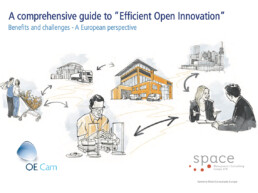
Efficient Open Innovation – Research Report
This European research report explores the benefits and challenges of Open Innovation (OI). An increasingly global business environment combined with rapid technological progress has changed the framework in which companies operate
Autonomous Teams – Research Report
OE Cam research investigated the role of Autonomous Teams in today’s organisations – how important are they to success and what are the challenges to making greater autonomy work?

The Digital Wave – Research Report on Successful Digitalisation
OE Cam European research focused on the human factors of successful digitalisation - what are the potential dilemmas on the digitalisation journey?
Human DNA in Innovation – Research Report
Real breakthrough innovation occurs when leaders let go of their natural tendency towards order and control and accept more of an unstructured way of doing things.