Why do our careers mean so much to us?
It’s important to understand what we gain from a career. Of course, most of us require a regular income and a certain level of job security, but beyond that, we also have psychological needs to fulfil.
Below are some of the most important psychological needs we look to fulfil at work (2). Consider how you might rate these in order of their importance to you personally:
- Meaning and purpose – we want to feel our work is valuable and that we are contributing to something larger than ourselves
- Achievement and recognition – we want to feel we have accomplished something and we are appreciated for our efforts. We seek opportunities for growth and advancement
- Autonomy and control – we want to have a say in how we do our work and feel empowered to make decisions
- Competence and mastery – the opportunity to enhance our skills and expertise
- Social connection and belonging – humans are social and we have a need for belonging in the workplace. Positive relationships with colleagues and a supportive work environment are important
- Work-life balance – time for personal pursuits, family, friends and leisure activities are important
- Fairness and equity – we need to be treated fairly, without discrimination or bias.
Which of the needs above were the most important for you? Does your current role fulfil those needs? Meeting these needs contributes to a fulfilling career, but one job alone may not meet all of these needs sufficiently. Of course, you can also fulfil some of these needs outside of work.
A less traditional way of meeting more psychological needs is to develop a ‘portfolio’ career. This could include a mix of a few days a week of paid work with an employer, some self-employed work and some voluntary or NED work, in the same, or a different field. Other benefits of this approach are variety and interest and spreading the risk of relying on one employer. Portfolio careers are also potentially more flexible, allowing for a better work-life balance.

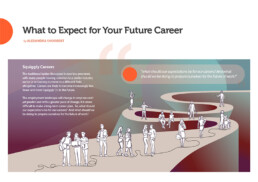
“what should our expectations be for our careers? And what should we be doing to prepare ourselves for the future of work?”
The 100 year life – what will living longer mean for work?
“The 100-Year Life” (3) by Lynda Gratton and Andrew J. Scott explores how we might need to restructure our lives as we are now all living longer. We will either need to work beyond the ‘expected’ retirement age or manage on a smaller pension when we retire. Gratton & Scott predict a multi-stage life in which we have two or three different careers. At some points we could work long hours and maximise our earnings, at other points we may balance work with raising a family.
You might consider spending more time experimenting and trying different roles before investing in qualifications. With a longer career it will be even more important to keep upskilling.
Career breaks will perhaps become more common for those who can afford to take them. Rather than working until retirement and then having all your time off at the end of your career, it might make sense to take shorter sabbaticals to travel, study or pursue other interests.

Embracing squiggly careers
This is an exciting opportunity to adjust our idea of careers from a linear path in a specific field to something potentially more interesting.
We may need to make more sideways moves to broaden our experience or consider portfolio careers or self-employment. Our career plans will need to be flexible and require regular review and reflection. We will need to keep up to date with changes in our industry and be proactive about exploring opportunities and using our transferable skills. Changing direction does not mean that you have wasted your previous efforts to learn and progress. The skills and experience from our different roles can combine to give us a unique combination of capabilities.
There is no doubt that whatever age we are, we will have to stay adaptable for the rest of our working lives. Life-long learning will be key and we might study and re-train at several points in our careers. Careers will continue to be self-managed with the onus on the individual to be proactive and undertake training and qualifications. However, if this sounds like hard work, it will also mean a more varied and interesting working life where we have the chance to try many different things and a meet a greater range of people.
To have a successful working life in the future, self-knowledge will be crucial. Rather than deciding on a specific career when we are young, it will be more important to learn about our interests, needs, strengths and values. With this knowledge we can then explore different opportunities which could fulfil these needs and give us a feeling of purpose and progression. We also need to be honest with ourselves about what we want from a career without being swayed by other’s opinions or held back by perceived expectations. A successful career does not necessarily mean you have to end up as a CEO, we all have our own definition of success. Our interests and requirements may also change at different stages in our lives.
“There is no doubt that whatever age we are, we will have to stay adaptable for the rest of our working lives. Life-long learning will be key and we might study and re-train at several points in our careers”
Here are a few additional tips:
- Be open-minded – no job is perfect so don’t wait for the 100% ‘perfect’ opportunity to come along
- Don’t focus on finding your ‘calling’ or ‘true purpose’ – not everyone feels like that. But you can still find a career that you enjoy
- Experiment – if you try something and it’s not quite right for you, it’s likely you will have still learned something from the experience and it will help you know what to do next
- Network – make connections and keep in touch with people. You never know when you may be able to help each other
- Build a greater understanding of your own identity – one that doesn’t focus entirely on your career
- Don’t compare yourself to others – follow your own path!
- Follow your interests – if you are not sure what to do next, see where your natural interests lead you: pick up books that look intriguing, speak to people who have interesting sounding jobs and attend events that could be inspiring.
Going back to the psychological needs mentioned earlier, if you want to discuss your future career, it may be worth investing in some executive coaching. OE Cam helps individuals to progress by facilitating self-awareness and honest reflection through 1:1 coaching and psychometrics.
We also deliver workshops such as the ‘Unlocking Women’s leadership Potential’ Programme which includes modules in discovering your authentic leadership style.
For a discussion about how to embrace squiggly careers, please email Alexandra at alexandra.shoobert@oecam.com
“We need to be honest with ourselves about what we want from a career without being swayed by other’s opinions or held back by perceived expectations”
REFERENCES
- “The Squiggly Career: The No.1 Sunday Times Business Bestseller – Ditch the Ladder, Discover Opportunity, Design Your Career” – (2020) Helen Tupper & Sarah Ellis https://www.amazon.co.uk/Squiggly-Career-Ladder-Discover-Opportunity/dp/0241385849
- Drawn from a range of authors including Maslow, Hertzberg and Pink
- “The 100-Year Life: Living and Working in an Age of Longevity” (2016) by Lynda Gratton & Andrew Scott Bloomsbury Books. https://www.amazon.co.uk/100-Year-Life-Living-Working-Longevity/dp/1526622831/ref=sr_1_1?crid=3JWE584JSTKZN&keywords=100+year+life&qid=1696336387&s=books&sprefix=100+year+life%2Cstripbooks%2C70&sr=1-1

ALEXANDRA SHOOBERT
Alexandra Shoobert is a Business Psychologist in OE Cam’s Organisation Development practice with expertise in applying psychological principles and other business tools to improve individual, team and organisation effectiveness.