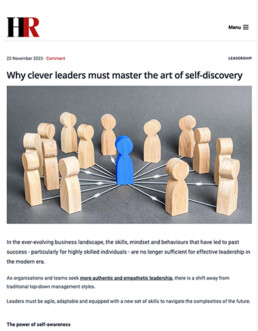
“Clever leaders must master the art of self discovery” says Martyn Sakol and Paolo Moscuzza in their article on coaching for HR Magazine.
In the ever-evolving business landscape, the skills, mindset, and behaviours that have led to past success – particularly for highly skilled individuals – are no longer sufficient for effective leadership in the modern era. As organisations and teams seek more authentic and empathetic leadership, there is a shift away from traditional top-down management styles. Leaders must be agile, adaptable, and equipped with a new set of skills to navigate the complexities of the future.
… Self-awareness is surprisingly difficult to master… despite 95% of people believing they possess self-awareness, only 10-15% actually do.
The power of self-awareness
The ability to know and manage ourselves and to foster and develop relationships with sensitivity and purpose are important skills for anyone at work today; for leaders, these skills are vital.
The correlation between elevated emotional intelligence (EQ) and effective leadership is well established, emphasising the invaluable role emotional intelligence plays in driving team performance, nurturing individual growth and fostering a harmonious work environment.
Hailed as the first component of emotional intelligence by psychologist Daniel Goleman, understanding how your emotions affect your performance – otherwise known as self-awareness – is a fundamental building block of effective leadership. It involves understanding our own strengths, weaknesses and the impact we have on others.
This heightened self-knowledge allows leaders to navigate challenges more effectively, identify opportunities for growth and develop authentic and impactful relationships with team members.
Yet self-awareness is surprisingly difficult to master. In her book Insight, organisational psychologist Tasha Eurich highlights the rarity and value of true self-awareness. Her research indicates that despite 95% of people believing they possess self-awareness, only 10-15% actually do.
Eurich defines self-awareness as perceiving ourselves, understanding others’ perceptions and fitting into the world. Developing it empowers us, even if it’s an uncomfortable process. But where to start?
Seeking external perspectives
Nothing can beat the power of seeing ourselves through others’ eyes.Feedback from colleagues, mentors and trusted individuals such as coaches, provides insights into how others perceive us and can help us bridge the gap between self-perception and reality.
Feedback from colleagues, mentors and trusted individuals such as coaches, provides insights into how others perceive us and can help us bridge the gap between self-perception and reality.
While power dynamics can make it challenging to receive candid feedback once you’ve reached a leadership role, finding ways to gather this intelligence is crucial.
Engaging in 360-degree feedback with colleagues, leveraging psychological profiling and working with an external coach can provide a more accurate picture of our strengths and areas for development. It’s reasonable to expect leaders who embrace these methods will have the potential to become more effective because blind-spots have been validated with evidence.
But becoming self-aware is just the start. Real transformation occurs when we use these insights to drive behaviour change.
Moving from being ‘unconsciously incompetent’ to ‘unconsciously competent’ requires conscious effort and deliberate practice. By consciously adapting our behaviours and communication styles, we can effectively convey our expertise, connect with others and expand our sphere of influence as leaders.
The drawbacks of knowledge, experience and power
As Eurich points out, experience and power can prohibit self-awareness, leading to overconfidence in our abilities and a lack of receptiveness to feedback.
Individuals with strong academic backgrounds can often have a win-or-lose mindset that hinders effective leadership. Even if you’re academically accomplished, if you fail to influence others, you’re not the smartest one in the room. Being overly confident in being ‘right’ can come across as arrogance and limit collaboration.
You might assume your thoughts and instructions are clear, but unintentionally leave others puzzled about what you want, merely sharing semi-formed ideas. Clever and quick-thinking individuals often have a natural inclination to provide immediate answers but must consider effective message delivery.
Experience and power can prohibit self-awareness, leading to overconfidence in our abilities and a lack of receptiveness to feedback
You might leap three steps ahead and make connections that are indispensable for the future of your business in 20 years’ time, but your impact can be constrained by your interpersonal interactions.
Being aware of these behaviours – and open to consciously changing them – is crucial for staying authentic and expanding your leadership influence.
The importance of interpersonal skills
Self-awareness is a key enabler for developing other essential soft skills. By understanding our strengths, weaknesses and how we influence others, we can navigate challenges more effectively and identify areas for personal growth.
Our work as executive coaches focuses heavily on enhancing leaders’ interpersonal skills, such as effective communication, active listening and engaging with stakeholders. While leaders are often promoted for their technical expertise, developing these softer skills is equally important.
Continual growth and reinvention
Embracing self-awareness allows leaders to reconceive and reinvent themselves continuously. By understanding who we are as leaders, we can create a solid foundation for ongoing learning, development and growth.
It is through self-discovery that we can adapt to new challenges, lead with authenticity and inspire those around us.
To learn practical tips for leaders to maximise their impact in a VUCA world, continue to the full article in HR Magazine.
“This heightened self-knowledge allows leaders to navigate challenges more effectively, identify opportunities for growth and develop authentic and impactful relationships with team members”
This is an excerpt. Read the article in full by clicking on the link below.
First published in HR Magazine 23rd November, 2023.
For more information about coaching, please contact Martyn Sakol martyn.sakol@oecam.com or Paolo Moscuzza at paolo.moscuzza@oecam.com