At the core of organisational culture is the way people treat each other. If you hear somewhere described as a ‘nice place to work’, what image does that conjure up for you? You might picture a place full of warm, friendly people who care about each other and are quick to help others out – all good things. But while it might sound great to work in a nice culture, could this be at the expense of something else? For example, what if a culture of being nice acts as a barrier to saying and doing the things that are genuinely best for people, performance and innovation?
Don’t be Nice – Be Kind
Striving to build a culture where people are nice to one another seems like a worthy goal. However, does a nice culture signal true kindness and respect – and genuinely drive wellbeing and success?
Let’s start by breaking down what is meant by ‘nice’ and how it differs to being ‘kind’. The word nice comes from the Latin word nescius, meaning ignorant (1). Today, nice is defined more along the lines of “pleasing, agreeable, delightful and amiably pleasant” (2).
Kind, on the other hand, which comes from the Old English (ge)cynde (3) – essentially, treating others as family – is now defined as as having a “good or benevolent nature or disposition” (4).
There is a clear difference here. On the one hand, there’s pleasing others, and on the other, there’s benevolence (or doing good to others). Would you rather work with colleagues who are trying to please you, or trying to do good?
Would you rather work with colleagues who are trying to please you, or trying to do good?
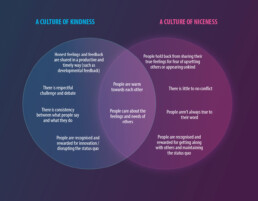
Nice and kind cultures have some similarities. As Figure 1 illustrates, the key area of overlap is that the people in both types of culture care about each other. Employees are mindful of individual needs and feelings, and they treat each other with warmth.
From here, this might go one of two ways. Towards a culture of kindness, where people are encouraged to express this care through openness and respectful challenge; or instead towards a culture of niceness, where people hold back from sharing their true thoughts and feelings for fear of upsetting others or appearing unkind. In a culture of niceness you might find that people avoid disagreeing with their colleagues, don’t challenge how things are done, or shy away from holding people to account.
So, what might cause this divergence between nice and kind cultures? Why in one organisation might you feel supported and encouraged to challenge and say what you really think, while in another you hesitate? And what can you do to build a kind culture in your organisation?
In a culture of niceness you might find that people avoid disagreeing with their colleagues, don’t challenge how things are done, or shy away from holding people to account
How to Avoid the Pitfalls of a Nice Culture
1. Be (respectfully) honest
Imagine that you’re discussing the solution to a problem with a colleague but you disagree on how to approach it. By being nice and aiming to please them, you might just say you agree with their idea. However, by aiming to do good (being kind), you would take the time to hear them out, share your honest thoughts and respectfully debate the pros and cons. By speaking authentically, not only are you then more likely to get to a better, more innovative solution between you, you’re also demonstrating your care for the situation you’re discussing, and showing that you trust the other person enough to speak truthfully. Also, when you do agree on an idea in future, they’ll know you’re being genuine.
A healthy level of conflict is key for driving innovation. Without a psychologically safe environment, employees won’t speak their minds or truly challenge the way things are done. Key to building a kind culture (instead of a nice one) is making it OK to respectfully challenge a colleague’s idea or opinion, without criticising them as a person. Authentic actions with kind intentions will lead to more innovation and stronger relationships.
Creating space for authenticity also contributes to wellbeing. In a 2022 review, researchers found that being honest is linked with stronger self-acceptance, more positive relationships with others, and could even have a protective effect on our long-term physical health (5). The mesolimbic reward system reinforces stimuli by releasing feel-good hormones such as oxytocin (6), a sensation that has been described as “the helper’s high” (7) which could help explain why kindness and wellbeing are so intertwined.
There are, of course, times when unfiltered honesty might not be wise. Before speaking your mind, you might want to ask yourself: What is my relationship like with the other person? Have I built sufficient rapport? Is this the right time and place? How will I convey what I want to say? Most importantly, how can I combine honesty with kindness?
2. Be inclusive (but not to a fault)
Inclusivity is critical in fostering wellbeing, ensuring everyone’s voice is heard and getting the most out of your people. But you can be too inclusive…
In a nice culture people might want to include everyone in the conversation. Whereas it’s kinder (and more efficient) to carefully consider why someone should be included. Not only does this ensure timely decisions are made at the right level, but only including people when there is a genuine opportunity for them to add value means demonstrating that you respect their time, energy and input.
3. Recognise and reward the ‘what’ AND the ‘how’
Caring about people and business is not an either/or. Kindness means being nice and holding people to account. A classic management dilemma is prioritising the needs and wellbeing of the individual whilst at the same time thinking about organisational targets and potentially navigating difficult conversations around individual performance.
It could be said that in recent years, how people get their work done has become more important than what they get done. This is certainly a risk for nice cultures. You get the behaviour you measure, so be sure to reward and recognise both the what and the how, in a way that makes it clear that they’re not competing concepts.
Managers and leaders play a particularly important role here. Questions for HR could be: What behaviours do managers recognise within their teams? Is it when people step up to help colleagues or when they achieve great results, or a mix of both? What signals are sent about how welcome challenge and feedback are?
An Authentically Great Place to Work
We started out by asking whether a culture of being nice acts as a barrier to saying and doing the things that are genuinely best for people, performance and innovation.
The recent focus on the individual and their wellbeing could be at risk of producing workplace cultures that value niceness above all else. But by building a kind culture that encourages and rewards respectful honesty, mindful inclusivity, and a balanced focus on performance as well as people, you’ll not only set the stage for innovation and success, but create an authentically great place to work.
The most important thing you can do to play a part in building this sort of culture in your organisation is to mentally reframe seemingly ‘tougher’ behaviours through a different lens. By being respectfully honest, you could be driving innovation, improving your relationships and helping people grow in their careers. By being mindful about who you’re including in meetings and discussions (and why), you’re respecting others’ time and energy. And finally, by focussing on performance and results as well as on people, you’re avoiding the traps of a ‘nice’ culture and creating a place where people can truly make a difference.

LUCY COX
Lucy is a Business Psychologist in OE Cam’s Talent Management practice with expertise in designing and facilitating development experiences. With more than five years’ experience in leadership development and employee engagement, she works with leaders and teams to uncover key strengths and opportunities for maximising their effectiveness. She does this using psychological tools and frameworks to design creative and progressive learning & development programmes that drive self-awareness, mindset and behaviour change.
References
- Nescius/ignorant – https://www.merriam-webster.com/words-at-play/nice-multiple-meanings
- Nice definition (pleasing, agreeable…) – https://www.dictionary.com/browse/nice
- Gecynde – https://www.etymonline.com/word/kind
- Kind definition (good or benevolent nature) – https://www.dictionary.com/browse/kind
- 2022 honesty review: Le et al 2022 – https://labsites.rochester.edu/lelab/wp-content/uploads/2022/08/Le-et-al.-2022-How-honesty-shapes-well-being.pdf
- Mesolimbic reward system: Moll, J., Krueger, F., Zahn, R., Pardini, M., de Oliveira-Souza, R., & Grafman, J. (2006). Human fronto–mesolimbic networks guide decisions about charitable donation. Proceedings of the National Academy of Sciences, 103(42), 15623-15628.
- Helper’s high – Dossey, L. (2018). The Helper’s High. Explore, 14(6), 393-399.