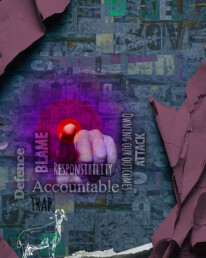
When things go well, we love a hero, but equally when things go wrong, we like a villain – someone to blame. This is not just an emotional response, it’s largely how we get things done. We pay people to do a job and expect a positive result.
Our lead article sets out our current crisis of accountability. Across business, politics and public life, we have had inquiries into significant failures which seem to unearth webs of excuses, blame and sloping shoulders that slough off responsibility. We examine what we can do about this and conclude the most challenging of all is culture. The need to create a way of working in organisations that accepts accountability.
Lucy Cox examines how we can better understand and change working cultures to embrace accountability. She delves into the world of anthropology which has been studying cultures for centuries to develop a richer, more insightful understanding of the complex series of factors which determine organisational culture.
Mike Thackray picks up on some of the biggest barriers to creating an accountability culture – defensiveness and fear. So often the pursuit of accountability is seen by people as a personal attack and so they respond to defend themselves and blame others – who in turn defend and blame, and so cycle goes on with no resolution. We fear accountability for some good reasons. Our job and livelihood are on the line. Performance management is a vital component exercising accountability, yet it has unintended consequences, as it can easily drive more fear and defensiveness, defeating its primary aim to reinforce accountability.
In our final article, Gary Ashton explains the role organisation design plays in delivering more accountable businesses. We can take a rational approach to mapping out roles & accountabilities and establishing clarity of decision making – however, you can’t know and control everything and there are limits to specifying every action. We need some assurance that our people will act in a particular way, with due consideration whatever the issue. So as leaders we try to set the tone through culture; that’s why we have values and encourage particular behaviours in order that our staff don’t ‘go rogue’.
At OE Cam, we believe that culture is a crucial lever to influence people’s behaviour when the rule doesn’t tell them what to do… We’ve taken inspiration from Gillian Tett’s book “Anthro-Vision”(1) to explore more effective ways of understanding and changing cultures. Talk to us about how we can help you build a culture of accountability.
Mark Goodridge
Chairman, OE Cam LLP
Reference:
1. “Anthro-Vision: How Anthropology Can Explain Business and Life” by Gillian Tett (2021) https://www.amazon.co.uk/Anthro-Vision-Anthropology-Explain-Business-Life/dp/1847942873

MARK GOODRIDGE, CHAIRMAN
Mark is Chairman at OE Cam and has built a reputation for his effective facilitation and development of Boards of Directors in both the public and private sectors. This has taken him to several countries and across a wide spectrum of organisations. His incisive and clear thinking, combined with his application of robust methods and tools, provides his clients with meaningful outcomes that add real value to them as individuals, as a Board and as a business. Mark’s focus is on better business outcomes, on supporting while challenging Board effectiveness, on enabling greater personal and collective effectiveness.