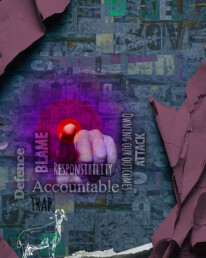
The current inquiry into the Post Office scandal brings the accountability of senior executives into stark relief. The contaminated blood inquiry tracks over many years with numerous opportunities to blow the whistle – but no one felt sufficiently accountable to do so.
The frightening thought about many of these failures is that the relevant information was known somewhere within the organisation – so the inquiries have focussed on who knew what and when.
But is accountability just about who knew what & when? And if they did know, what they did about it? Is accountability just driven by knowledge? Is it an all-embracing concept of ‘the buck stops here’… Or is it subject to limitations?
From the Post Office Limited inquiry chaired by Sir Wyn Williams, there are lots of caveats being given to executive accountability…
… I didn’t know!
… They didn’t tell me!
… I am too busy!
… I can’t be expected to know everything!
But is accountability limited by what you are told by your executives? Is it limited to those things that you have direct influence over? Is it just about the known or does it include the unknown? Is there a ‘reasonableness’ test? And if so, what is it and who should apply it?
One ex CEO of the Post Office stated in his evidence that he was accountable for the actions of PO Ltd but then went on to say that he was focussing on the day-to-day running of the business and its £1m daily loss which seemed to dilute his acceptance of accountability of Postmaster/mistress prosecutions… it was not on his radar screen (1).
We pay our senior executives large sums of money to be accountable. Accountable to shareholders and the communities they serve. How they discharge that accountability is the focus of this article.

Is accountability just driven by knowledge? Is it an all-embracing concept of “the buck stops here”… Or is it subject to limitations?
Responsibility vs. Accountability
I make a distinction between ‘responsibility’ and ‘accountability’. Responsibility is for those aspects of the business an individual has under their control or influence, assets, budgets, people and relationships. Accountability is much broader, it is about delivering outcomes, indirect control, influence and stakeholders.
No Chief Executive can know everything going on in their organisation. Should Dale Calhoun have known that window bolts were incorrectly fitted to Boeing 737Max windows? Accountable executives have to judge what is material, what deserves their attention, not just the data that they are fed. They need experience and intuition to challenge and probe. The biggest complaint I heard of a CEO I coached was that her executives never knew where she would ‘land’ or focus her attention. Another CEO would interrupt the flow of a highly polished presentation to probe ‘why’. These people were doing their job. They were taking all the data feeds, challenging them, synthesising them and finding what didn’t add up. They were not solely relying on management conventions of KPI’s and algorithmic reporting.
Public inquiries are great exhibitions of excuses and defensive testimonies
Listening to many hours of the Horizon Inquiry testimony from Chairs, Chief Executives and Directors alike, all were united in accepting the consequences to have been dire for the falsely accused but also united in ‘this can’t be put at my door – ‘they’ didn’t tell me’. It’s fascinating how disembodied some of the accounts became – CEO’s talking about ‘The Post Office’ and the ‘Institution and governance of the Post Office’. Who do they imagine these entities to be other than themselves? At that level, you are accountable for the ‘Institution’ – the Post Office is you! You are accountable for all that is done in the name of your company. Therein lies the complexity and the challenge of the role.
Accountability is for the known and the unknown. It is not limited by knowledge and data systems – that’s the whole point! Acts of God, War, Insurrection, Criminal Acts, Force Majeure, Known Unknowns, Unknown Unknowns – that is the accountability challenge. There are no qualifications. The paradox is that the greater your accountability, the greater the likelihood of your ignorance of what you are accountable for and the more you have to rely on others to assure your accountability. This is the complexity of accountability – and for me, therein lies its essence. If it is embroidered with excuses and limitations, the term loses its value.
Accountability is about outcomes and consequences. Responsibility tends to be seen in relation to tasks. Accountability goes beyond the job description. If we just make Executives accountable for their tasks, then who is accountable for connecting all the tasks – the collaboration required to deliver a complex product or service?
The question now is how to make accountability work, how to establish an accountability culture and reduce the defensiveness we have seen so starkly in public inquiries. (See my colleague, Mike Thackray’s, article on defensiveness).
This is the complexity of the definition of accountability - and for me, therein lies its essence. If it is embroidered with excuses, the term loses its value.
In pursuit of an accountability culture
There are three ways to exercise accountability. Establishing effective systems of control; adopting good management practices and thirdly, and most elusive of all, establishing an accountability culture.
1. Establishing effective systems of control
We have a body of legal, institutional and governance structures and processes set out in varying degrees of specificity for private, public and not for profit companies. In the financial services industry, the Senior Managers Certification Regime (SMCR) being one of the most stringent. The Financial Reporting Council sets out an increasing level of non-financial reporting alongside the financial requirements. These are the ‘systems of control’. Other examples are the:
- Stewardship code
- Study on sustainability assurance
- Code of Corporate governance adopted by the London Stock Exchange (LSE).
2.Adopting good management practices
We have a rather amorphous set of what I’ll call ‘good management practices’. Strategy, planning, targeting, measuring, auditing, performance managing, remuneration systems – each of which have reporting channels which may, or may not, reach the Board.
Critical is the design of the organisation itself as my colleague, Gary Ashton, explains in his article. Designing jobs with clear lines of accountability, as well as task units, is vital.
Systems of control and good management are important, but not sufficient – clearly not so in News International and PO Ltd, Boeing, VW emissions, 2008 financial crisis… If simply telling people to adopt the systems of control and good management were sufficient, then we wouldn’t have the problem.
The missing piece, for us, is the lack of a coherent understanding of how these systems of control and good management practices influence and drive human behaviour. This brings me to the third element which is often in the ‘too difficult’ box – culture.
3. Building a culture of accountability
This is the ‘soft side’ of governance and control and here we enter a world which is irrational, fluffy and hard to pin down.
Business success is most often attributed to brilliance of individual leadership. However, business failure is, more often than not, attributed to culture. What this actually means is at best ambiguous, and at worst, sees organisational behaviour defined in a binary way in terms of ‘Goodies’ (those that get it) and ‘Villains’ (bad actors, who don’t get it).
One ex Chairman of the Post Office is quoted as having said “The Post Office scandal is unbelievable” (2). I disagree, it is frighteningly believable. Where accountability is low, no one is looking at the total picture. Where was the challenge? Where was the scrutiny?
Within the organisation itself there are competing forces and counter currents that dilute openness, and obscure what’s really going on. All of these behaviours can, in most cases, be explained away without any reference to any anyone being ‘stupid’.
The missing piece, for us, is the lack of a coherent understanding of how these systems of control and good management practices influence and drive human behaviour. This brings me to the third element which is often in the ‘too difficult’ box – culture
We ask people to be open, but if they are, what are the consequences? In what ways do other aspects of the organisation, such as the hierarchy and the communication channels, actually make it easy to ‘be open’?
Back to the Post Office – I see fear, fear for my job, fear of disloyalty and I see what happens to the whistle-blower. Some good management systems themselves promote defensiveness. Individual accountability means loss of bonus, poor reviews, poor progression – I’m going to fight my corner.
There are ways of defining and measuring culture, but many are inadequate. At OE Cam, we draw on ways of understanding what drives the behaviour. My colleague, Lucy Cox explores this in her article.
Does accountability matter?
Does accountability even matter? Bad stuff will always happen. Is good governance just theatre? A performative art in the amphitheatre of heroes and villains. Is it a gladiatorial spectacle and actually a key part of how corporates recover from crises?
No, it does matter. It matters deeply to the performance of any organisation. Without it, we drown in a sea of plausible excuses, sub postmasters and mistresses are wrongly condemned and bad blood courses the veins of the innocent.
Reference:
1. https://postofficeinquiry.dracos.co.uk/phases-5-6/2024-04-16/#questioned-by-mr-stevens – David Mills, former CEO, Post Office Ltd.
2. Allan Leighton – https://www.bbc.co.uk/news/live/business-68832448

MARK GOODRIDGE, CHAIRMAN
Mark is Chairman at OE Cam and has built a reputation for his effective facilitation and development of Boards of Directors in both the public and private sectors. This has taken him to several countries and across a wide spectrum of organisations. His incisive and clear thinking, combined with his application of robust methods and tools, provides his clients with meaningful outcomes that add real value to them as individuals, as a Board and as a business. Mark’s focus is on better business outcomes, on supporting while challenging Board effectiveness, on enabling greater personal and collective effectiveness.