In the Room or Zoom? Meeting Behaviour & the Misinterpretation Trap
by Mariam Mirza
I recently saw a tweet that said “poor communication leaves too much room for imagination and misinterpretation” and it got me thinking about our current virtual workplace situation.
OE Cam’s experience in working with global organisations has meant that we were discussing effective virtual communication as early as 2013. However, the uncertainty that dominated 2020 (which continues this year), has left many of us feeling disconnected / unsure and these feelings have shown to leak into the ways we communicate with others, particularly affecting meeting behaviours during online or VC meetings.
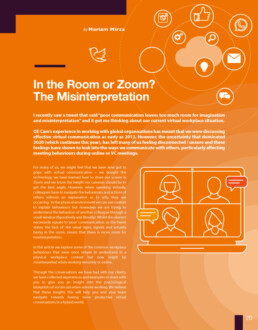
For many of us, we might feel that we have now ‘got to grips’ with virtual communication – we bought the technology, we have learned how to share our screen in Zoom and we know the height our cameras should be to get the best angle. However, when speaking virtually, colleagues have to navigate the behaviours and actions of others without an explanation as to why they are occurring. In the physical environment we can use context to explain behaviours but nowadays we are trying to understand the behaviour of another colleague through a small window (figuratively and literally). Whilst this doesn’t necessarily equate to ‘poor’ communication, as the tweet states, the ‘lack of’ usual signs, signals and actually being in the room, means that there is more room for misinterpretation.
In this article we explore some of the common workplace behaviours that were once simple to understand in a physical workplace context but now might be misinterpreted when working remotely or online.
Through the conversations we have had with our clients, we have collected experiences and examples to share with you to give you an insight into the psychological blueprints of social cues when working remotely or online. We believe that these insights this will help you and your team navigate towards having more productive virtual conversations in a hybrid world.
QUIZ
Take the time to think about the following scenarios and how you might perceive the situation. There are no right or wrong answers…
Remote working scenario 1: Silence
You are leading a virtual meeting and you have just asked your team a question on X. Some members of the group are very vocal with their opinions however, two members of the group remain silent. What could this silence mean?
- They do not like the members in the group and therefore do not want to participate
- They have heard the question and are using some time reflect before giving their answer
- They have their email window open and they have been distracted by replying back to that email, therefore they have not been listening and cannot answer the question
- Other…
Remote scenario 2: Looking away from the screen
In that same meeting, you notice that a team member is continuously looking away from the laptop screen. What could this behaviour mean?
- Using another form of communication (text/instant messenger), a small number of colleagues are separately discussing another colleague on the video call. You feel a sense of in-group/out-group behaviour
- Distracted by the working from home environment and therefore not currently engaged in the virtual meeting
- Taking a break/resting their eyes
- Other…
Remote scenario 3: What does mute on and camera off mean?
- The individual is not mentally present for the meeting and has no intention of contributing
- The individuals(s) have been on many video calls/meetings prior to this meeting and would like some ‘screen break’ tim
- Dealing with a working from home issue (e.g. family or delivery)
- Other…
Remote scenario 4: Hearing typing and clicking when on a video call
- Answering emails that are not relevant to the meeting agenda but the individual considers to be urgent
- Team members might be taking notes from the meeting
- Using another form of communication (text/instant messenger), a small number of colleagues are separately discussing another colleague on the video call. You feel a sense of in-group/out-group behaviour
- Other…
This short quiz illustrates that there are many different ways of interpreting meeting behaviour and with remote working it is much easier to jump to the wrong conclusion.
What does this mean for more effective hybrid working? Well, the responsibility for an effective remote meeting is on both the leader and the meeting attendees.
Leaders will need to use skills in empathy (under the umbrella of emotional intelligence) to demonstrate greater understanding and on some occasions, give their colleagues the ‘benefit of the doubt’ – working remotely has its challenges and leaders should be considerate of that.
At the same time, those colleagues attending the meeting should ensure they are doing what they can do be mentally present for the meeting. A few examples of this could be: getting regular screen breaks where possible to feel refreshed (as can be) for the next virtual meeting, not answering calls when in the meeting and, whilst disturbances can’t always be helped, reminding other members of your household when you will be in a meeting.
In your experience, what have you been doing differently to show empathy and understanding to your colleagues who are working remotely?
For more information about effective meeting behaviour, please contact Mariam Mirza.

MARIAM MIRZA
As a Business Psychologist Consultant, Mariam Mirza designs and delivers training workshops on topics such as resilience, team work and coaching & mentoring. She has particular expertise in designing and implementing 360 degree feedback as well as pulse engagement surveys. Mariam also has a range of experience in using key psychometrics to drive forward individual development as well as selection and assessment.