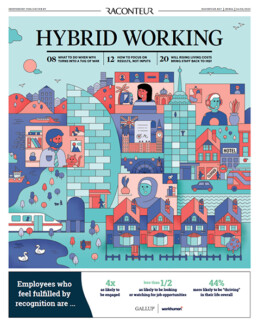
This is an excerpt from The Times supplement “Hybrid Working” (26 May 2022). Download the full article below.
“When WFH turns into a tug of war”
by Cath Everett
As some employers seek to impose a full-time return to the office, disgruntled workers are starting to vote with their feet. What can HR do to balance their conflicting interests?
As the disparity between what employers and employees want from hybrid work grows, the practice has arrived at something of a crossroads. Most companies have come to accept that some sort of hybrid model is appropriate and have been experimenting with various methods. But a growing number of firms have hit the headlines recently by rejecting the concept entirely…
In this article, journalist Cath Everett talks to experts about what HR can do to balance conflicting interests. Comments from OE Cam’s Mike Thackray have been included below, but please download the PDF to read the full article on page 8.
Until recently, productivity used to be the key factor for advocating a return to the office. The received wisdom is that high performance is easier to achieve when everyone is located in the same place, because this makes it easier for them to collaborate and innovate. But an emerging argument in favour of summoning everyone back to base centres on the cultural damage that remote working could have on an organisation.
“Much of the drive by leaders to get employees back to the workplace is based on a fear of not being in control and of people taking the mickey,” argues Mike Thackray.
“The problem is that many people are reluctant to lose the enhanced work/life balance they gained when they were obliged to work remotely at the start of the pandemic. They also consider themselves more productive at home and resent the implied lack of trust“, he says. Such factors could become corrosive in the longer term.
HR has a role to play in developing some guiding principles and also in encouraging teams and their managers to discuss what’s right for them…
As part of this process, other key roles for HR will be to recruit more empathetic managers and help existing ones to develop better people skills. Such qualities are becoming increasingly important in a hybrid working environment to create the trust and psychological safety required to get the best out of employees and ensure that teams work together effectively.
On the one hand, this is “about ensuring that leaders develop a clear understanding of what outputs they’re seeking and also the confidence to handle ambiguity”, according to Thackray.
On the other… this is about adopting a more tailored approach to people management. It may take more effort than handling traditional, homogeneous ways of working, but the potential benefits will make it worthwhile.
“Much of the drive by leaders to get employees back to the workplace is based on a fear of not being in control“
Read the article in full by downloading the PDF below.
For more information, please contact Mike Thackray at mike.thackray@oecam.com.