Building the 'One Team' Feeling in Hybrid Workforces
by Julie Brophy
We recently heard this story from a senior leader about their experience of working remotely. They were involved in a meeting with the objective of making a significant decision about a future investment. Some attendees were physically sat together in an office, while others joined by VC from a variety of locations. During the meeting, three of the office-based people were seen engaging in a side conversation just before a coffee break. When the meeting reconvened, it became clear that the decision had been made in the room without the full involvement of the remote leaders.
This highlights a couple of factors that organisations need to consider as they make plans for if, when, and how to bring people back to shared locations:
- The formation of ‘in-groups’ and ‘out-groups’
- Present privilege
I’ve previously written about ‘in-groups’ and ‘out-groups’* and how the work of Tajfel and Turner (1) as well as Hunter (2) show the ease with which they can be formed. In this article I’ll focus on a factor that will become increasingly important as the move towards hybrid workforce gathers pace: the formation of groups based on location.
The remote argument
While some people were working ‘remotely’ before lockdown, we have heard anecdotally that there have been some unexpected benefits from the dramatic increase in remote working. Technology agendas were fast-tracked and communications strategies became more ‘considered and inclusive’, so experienced remote workers actually reported feeling more connected than before.
Another positive effect of the lockdown has been to challenge the traditional prejudices that some leaders and managers have had about the effectiveness of employees who are usually based in the office when they ‘work from home’. The fact that many organisations have been able to function successfully through Covid runs counter to the old arguments used to restrict remote working.
Lockdowns offered organisations an opportunity to review how much real estate they need. For example, Gerald Walker, CEO of ING Americas, expects many financial institutions will move to a hybrid model with the previous norm of going into financial hubs like London’s Canary Wharf fading away.
But as organisations make the practical plans for hybrid working they also need to consider the psychological / emotional factors. Will people want to return to the office? How often? What about people who want to work in a shared location every day? And when people are working in a hybrid working pattern, how will the organisation mitigate the formation of ‘in-groups’ and ’out-groups’?
When the meeting reconvened, it became clear that the decision had been made in the room without the full involvement of the remote leaders…
‘In-groups’ and ‘out-groups’ and the consequences
There are clear benefits to the formation of ‘in-groups’. Individuals are able to quickly become a team based around a common characteristic (in this scenario sharing a location) which enables them to work effectively together to achieve their objectives.
Present privilege – this advantage is limited to those who are working in a shared location where they have more direct access to leaders and managers which is difficult for remote workers to recreate.
However, there are also drawbacks that can impact the performance of individuals and teams.
During the easing of restrictions in autumn 2020, one of our clients had begun to bring people back into two different office locations. While the vast majority of leaders were based in the Head Office, one executive director, worked in a hub office due to its proximity to their home. As a result, a different group of employees had present privilege, and this changed the power dynamic of the organisation. While this may not be a bad thing, it should be a conscious decision rather than an unexpected consequence of hybrid working.
A different group of employees had present privilege, and this changed the power dynamic of the organisation. While this may not be a bad thing, it should be a conscious decision rather than an unexpected consequence of hybrid working
Unconscious bias – While location-based ‘in-groups’ and ‘out-groups’ are affected by the unconscious biases to others, research shows that ‘in-groups’ based on familiarity have specific biases. They are nicer to other group members and more forgiving around under performance than to people in the out-group. This can cause issues for a business when deciding who to involve in a project or allocating work. It can also affect whether difficult performance conversations are biased against people working at home. Leaders need to ensure that these types of decisions and conversations are based on skills and capabilities and not present privilege.
Isolation and loneliness – In 2015 Professor Nicholas Bloom of Stanford University (3), conducted a research project on home working with Ctrip, a Chinese travel company. While there were benefits for both the organisation and the individuals, after nine months more than half of participants wanted to return to working fully in the office. The reason most often given was feelings of isolation and loneliness.
Lockdown has dramatically increased the likelihood of employees feeling isolated and lonely. Not only cut off from many friendship groups, remote working means working alone without the normal social support that comes from being with colleagues. Essentially individuals have become an ‘out-group’ of one and as organisations potentially look to reduce their real estate, the opportunity to interact with colleagues will reduce further.
Negative self-belief – In recent coaching sessions we’ve seen an increasing number of leaders questioning their own performance and doubting personal capability.
When we are in a shared working environment, as well as formal feedback on our performance, we receive adhoc positive reinforcement such as a passing comment of support, an informal thank you, someone passes your desk and takes the opportunity to ask your opinion. These signals of capability are not the kinds of thing that people naturally think of doing on online as it takes more effort to arrange a mutually convenient time and set up the VC. As a result, people working remotely are more likely to develop negative narratives about themselves. My colleague Toni Marshall’s article explores this in more detail.
Essentially individuals have become an ‘out-group’ of one and as organisations potentially look to reduce their real estate, the opportunity to interact with colleagues will reduce further.
Indicators of ‘in-groups’ and ‘out-groups’
While there are advantages to ‘in-groups’ there are likely to be more disadvantages. This is because for each in-group there will be at least one out-group. To know whether the organisation’s hybrid working approach is giving rise to the two groups there are a number of indicators to be aware of:
Change in language – look for changes in the language people are using:
- Are they using negative language about their performance or ability to deliver required outcomes?
- Are people talking about ‘them and us’ or questioning the capability or ability to deliver to time / quality deadline of colleagues who are working remotely?
Increase in low level conflict between colleagues – look for an increase in conflict during meetings and the slowing down of decision making:
- Are there more challenges being made in meetings and does the body language / tone of voice of individuals have a conflict undertone?
- Are decisions taking longer to take with people needing more debate / evidence to support options?
These indicators come from a loss of social capital within the group. Culture is developed through shared experiences, personal stories and how we behave towards one another. There is anecdotal evidence that this ‘common understanding’ of how we work together is declining as a result of remote working. If these behavioural norms that we follow are reduced, conflict and misunderstanding will increase. Collaboration and creativity will decrease, which will negatively impact long-term productivity and ultimately an organisation’s responsiveness to market changes and customer’s expectations.
Working remotely provides fewer opportunities to share those real ‘bonding’ experiences which are critical to developing a strong culture. As humans, the physical, non-verbal cues and signals are so important in building trust and chemistry. Experiences shared online tend to follow a broadly mechanical pattern which does not provide breadth of experience or those adhoc informal interactions, which go on to become cultural artefacts within the group – the stories, language and in-jokes. In addition, there is less positive reinforcement of the ways of doing things, as peoples’ behaviour is less visible when working remotely or on VC.
Collaboration and creativity will decrease, which will negatively impact long-term productivity and ultimately an organisation’s responsiveness to market changes and customer’s expectations.
What leaders/managers can do
When developing their organisation’s hybrid approach, leaders are often seeking to get the best of both worlds – the flexibility and autonomy of remote working and the structure and sociability of being in a shared location.
Whatever the design of hybrid working, the potential for ‘in-groups’ and ‘out-groups’ will be there. However, there are things that can be done to reduce any negative impact:
- Deal with unconscious bias – Leaders can raise awareness, discuss and challenge underlying beliefs. They can highlight evidence that doesn’t support assumptions about the ‘out-group’. Interventions and processes that mitigate the impact of the bias can then be developed. In addition they can review their processes and language used in their documentation to ensure it doesn’t reinforce any biases.
- Actively manage the time spent in a shared location – bring together people from the two different groups which will help develop the understanding of others and challenge the underlying beliefs and biases
- Mitigate present privilege – Leaders can role model the hybrid working pattern, spending time working remotely a well as in shared locations. While working in the same location as colleagues, be very visible and try to balance the time spent face-to-face with a mix of different teams / individuals across any of the hub offices
- Reduce negative self-limiting beliefs – talk to colleagues and challenge the self-limiting views they hold about themselves. Use positive bias language to acknowledge good performance both formally and informally
- Maintain levels of social capital – Reinforce the organisation’s purpose and values. E.g. sending nudges about the organisation’s values and ways of working; arrange activities that can safely bring colleagues together to build new joint experiences and strengthen social networks
- Widely communicate success stories – where the behaviour of colleagues reflects the desired culture and values
- Limit isolation and loneliness – reach out to individuals to find out how they are and what support they need. Role model how to make connections with colleagues by arranging meetings with a diverse group of employees and share different experiences of hybrid working.
Conclusion
There are benefits to hybrid working for both employee and organisation. It allows employees to benefit from the flexibility of working remotely and the sociability of working face-to-face with colleagues. For organisations, it offers the chance to review, and potentially reduce, expensive real estate.
However, as organisations begin to bring people back to some degree of working in shared spaces, they also need to also consider the emotional and psychological impact. Being aware of, and consciously designing an approach which mitigates formation of in-group / out-groups will help rebuild social capital and keep the ‘one team’ feeling.
This article has briefly covered what is a broad and complex subject, if you would like to continue the conversation please contact Julie Brophy.
Rebuilding Social Capital: Time to Re-energise your Culture?
Extended periods of remote working through lockdown have inevitably made a dent in an organisation’s social capital… so how do leaders reconnect and build that ‘one team feeling’ again?
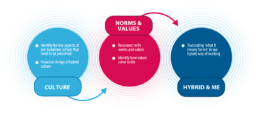
For employees returning to a new hybrid workforce, rebuilding social capital is about:
- Re-establishing social networks
- Reinforcing trust and reciprocity
- Reconnecting with norms and values
- Reengaging with the organisation
In this mini programme, OE Cam can work with your leaders to identify cultural attributes of the new hybrid working culture. Through short induction / on-boarding styles of workshop we help reconnect employees with your company’s norms and values and then establish buy-in to hybrid ways of working.
For more information, please contact julie.brophy@oecam.com

JULIE BROPHY
Julie Brophy is a highly experienced consultant working in OE Cam’s Organisation Development practice. She specialises in helping clients to improve the effectiveness of individuals, teams and organisations through re-designing and implementing organisation structures and management processes, post-merger integration and culture change.
References
- Jost & J. Sidanius (Eds.), Key readings in social psychology. Political psychology: Key readings (p. 276–293). Psychology Press.
- ‘Flying-through-the-air Magic’: Skateboarders, Fashion and Social Identity (2001) Janine Hunter
- “The productivity pitfalls of working from home in the age of COVID-19” (2020) Professor Nicholas Bloom, Stanford University